


HOMEAI Trust
Trust, built into every agent.
Every AI agent gets a verified identity, clear permissions, and a record of what it did and why.

Overview
Identity, Authorization, and Accountability, For Every Agent
Agents now act faster than most security tools can watch them. AI Trust checks identity and permission before every action, not after.

Aproach
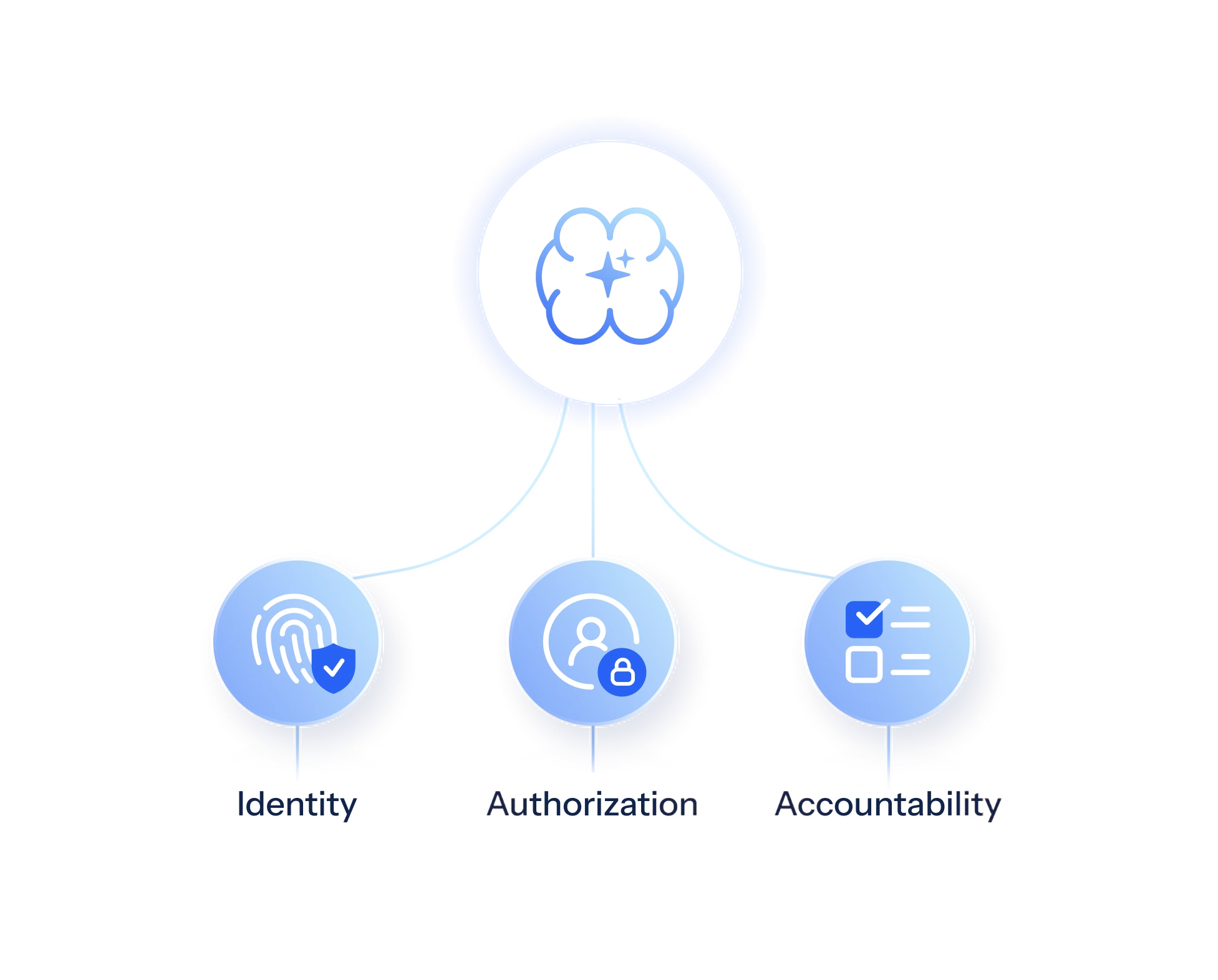
Three Questions. Answered Before Every Action
Who is this agent? What can it do? What is it accountable for? All three, automatically, no code changes required.
Benefits
What AI Trust Solves for Agent Security
-

Ungoverned agent actions
Nothing runs unless it’s explicitly permitted.
-

Prompt injection and jailbreaking
Malicious inputs are caught before they reach execution.
-

Unverified agent identity
Every agent is uniquely verified. No shared credentials, no impersonation.
-

Human approval gaps
Sensitive actions wait for a real person to approve them.
-

PII and data exposure
Sensitive data can’t leak through a tool call.
-

Audit gaps in regulated environments
Every action, logged and traceable, automatically.
Features
Core capabilities
One platform. From verified identity to audit-ready evidence.
-
Every agent receives its own X.509 certificate and OAuth 2.1 credentials. Mutual TLS verifies the agent at connection time — uniquely identifying it across all platform interactions.
-
Deny-by-default policy enforcement via OpenFGA. Every tool call is evaluated against the agent’s permission scope before it executes — with support for time-limited permissions and governance reviews.
-
Inspects every tool call before and after execution. Blocks prompt injection, redacts PII and secrets, enforces I/O guardrails, and filters retrieved documents by user permissions.
-
Sensitive actions trigger real-time approval requests to a designated human approver’s device via CIBA. The agent pauses, awaits consent, then resumes — or is blocked.
-
All agent activity streams into a unified event store. Configurable thresholds detect rate spikes, error bursts, and off-hours activity. Policy violations trigger alerts or automatic agent suspension.
-
On-demand audit trail export and SIEM integration. Reports aggregate activity by period, agent, and event type — supporting EU AI Act, SOC 2, HIPAA, NIST AI RMF, and OWASP Agentic Top 10.

AI Trust in action
From Integration to Governed Deployment. Three Steps
KOBIL’s low-code SuperApp builder gives you full control without a full development team.
-
Integrate
Install the SDK. Wrap your tool calls. Nothing else changes.
-
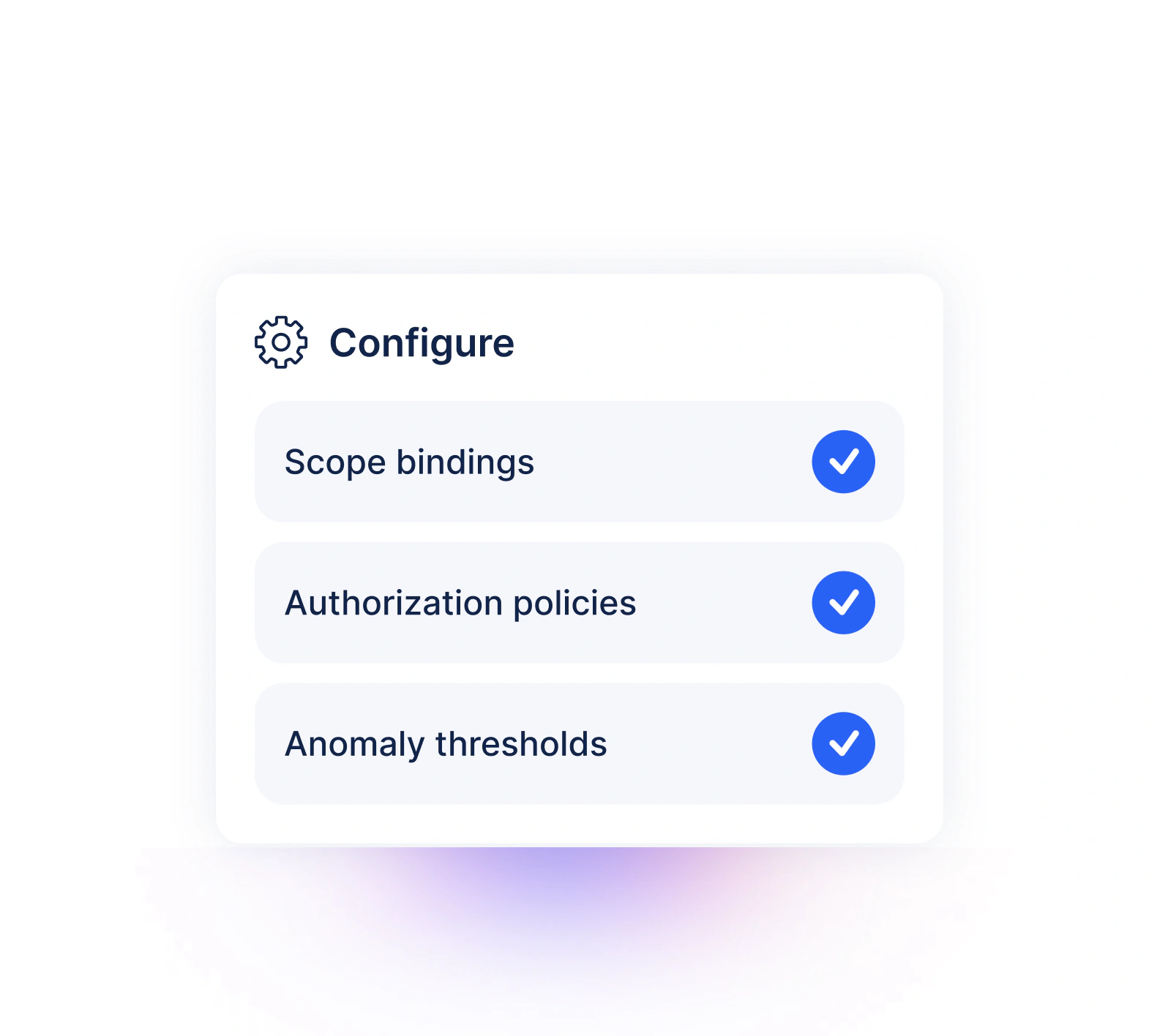
Define controls
Set permissions and thresholds once, centrally. Not agent by agent.
-
Monitor, enforce, report
Every action tracked. Violations stopped automatically.


FAQ AI Trust
-
KOBIL AI Trust is an identity, security, and governance platform for AI agents. It gives agents verifiable identities, controlled access, protected credentials, runtime policy enforcement, and auditable activity across enterprise systems.
-
AI agents can act autonomously, call tools, access data, and execute tasks at machine speed. A dedicated identity allows each agent to be authenticated, authorized, monitored, limited, and revoked without treating it as a human user or an unmanaged shared service account.
-
It helps address agent impersonation, excessive permissions, credential exposure, unapproved tool use, unclear delegation, shadow agents, and incomplete audit trails. The controls focus on who the agent is, what it may do, and who is accountable for its actions.
-
The platform combines Agent IAM, Agent Vault, Agent Guard, and Agent Audit with a central control plane and developer SDKs. Together they manage agent identity, credentials, permissions, runtime decisions, and evidence.
-
Each agent receives a verifiable identity and uses controlled credentials or tokens to access approved resources. Standards-based flows can include OAuth 2.1, PKCE, token exchange, and cryptographic proof-of-possession such as DPoP, depending on the integration.
-
Fine-grained policies define the resources, actions, context, limits, and delegation available to an agent. Agent Guard evaluates relevant requests at runtime so access can be allowed, restricted, escalated, or denied according to policy.
-
Yes, when explicitly authorized. KOBIL can separate the agent’s own identity from delegated user authority, issue scoped permissions for the task, and retain evidence of both the agent and the accountable human context.
-
Agent Vault keeps sensitive credentials outside the agent’s prompt and business logic and releases them only under defined policy. Short-lived, scoped, and proof-bound tokens can reduce the risk created by reusable bearer credentials.
-
Yes. Policies, tokens, credentials, or the agent identity can be restricted or revoked centrally. The appropriate response can be triggered by risk signals, policy violations, lifecycle events, or an administrator decision.
-
Agent Audit can record identity, authorization decisions, delegated authority, resource access, policy outcomes, and relevant transaction context. This creates evidence for investigation, governance, access review, and compliance reporting.
-
Not necessarily. It is designed to extend existing identity and security architecture with controls specific to AI agents. Integration can connect current identity providers, APIs, applications, policy systems, and security operations.
-
Its primary scope is agent identity, access, credentials, runtime enforcement, and auditability. It complements model-safety, prompt-security, content-filtering, and output-evaluation tools rather than replacing them.
-
KOBIL provides SDKs for Python, TypeScript, and Java and is designed to work across different agent and application environments. The integration path depends on the agent framework, APIs, tools, and identity architecture in use.
-
It provides technical evidence and controls relevant to least privilege, human accountability, access review, auditability, and secure operation. These capabilities can support programs aligned with the EU AI Act, NIST AI RMF, ISO/IEC 42001, and sector rules, but do not create compliance on their own.
-
Choose one agent, the systems it needs to access, the actions it performs, and the person or team accountable for it. KOBIL can then model the identity, permission, credential, runtime, and audit controls required for a proof of concept.


Secure AI Agents
Govern AI Agents Before Production
